T o calculate the right storage unit size, inventory all items you plan to store, measure large furniture pieces, estimate your total square footage needs, then add 20 to 30 percent extra space for walkways and organization. A 5x10 unit fits a one-bedroom apartment; a 10x10 holds two to three rooms; a 10x20 accommodates a full house or vehicle.
| Key Points: | |
|---|---|
| • | A 5x5 unit (25 sq ft) holds 10 to 15 boxes and small furniture; ideal for seasonal items |
| • | A 10x10 unit (100 sq ft) fits contents of two bedrooms or a 16-foot moving truck |
| • | Add 20 to 30 percent buffer space beyond your calculated needs for access and future items |
| • | Undersizing by 25 to 50 percent is the most common mistake, leading to costly upgrades |
| • | Standard unit height is 8 feet; stack boxes to maximize vertical space |
Step 1: Create a Complete Inventory of Your Items
Start by listing everything you plan to store, room by room. This systematic approach prevents the common mistake of forgetting items and ending up with a unit that is too small. Group items into categories: furniture, boxes, appliances, sports equipment, and seasonal decorations.
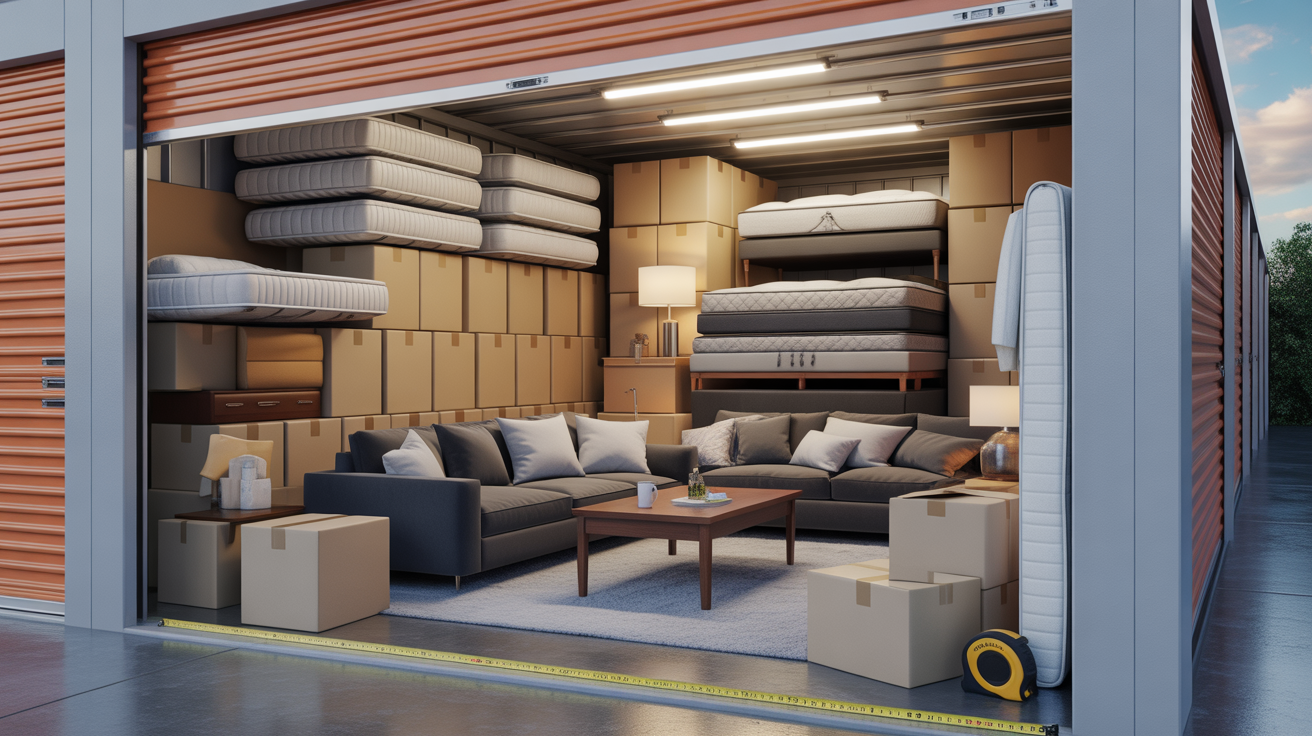
For each category, note the quantity and approximate size. A queen mattress measures roughly 60 by 80 inches. A standard sofa runs 80 to 90 inches long and 35 inches deep. Medium moving boxes (18 by 18 by 16 inches) are the most efficient for stacking and typically hold 30 to 65 pounds each.
Business customers storing inventory should count pallets or shelving units. Residential customers moving between homes should include items currently in closets, garages, and attics, which are often underestimated by 30 percent or more.
Step 2: Measure Your Largest Items
Your largest items determine the minimum unit dimensions you need. Measure the length, width, and height of furniture pieces that cannot be disassembled. A king bed frame requires at least 76 by 80 inches of floor space when stored flat, though standing it against a wall reduces the footprint significantly.
Common furniture measurements to reference:
- Dresser: 60 to 72 inches wide, 18 to 20 inches deep
- Dining table: 36 to 48 inches wide, 60 to 96 inches long
- Refrigerator: 30 to 36 inches wide, 67 to 70 inches tall
- Washer or dryer: 27 to 28 inches wide, 38 to 44 inches tall
Disassemble furniture when possible. Removing table legs, bed frames, and shelving units can reduce your space requirements by 15 to 25 percent. Keep hardware in labeled bags taped to the corresponding furniture piece.
[CENTER_IMAGE]Step 3: Match Your Items to Standard Unit Sizes
Storage units follow standard dimensions that fit your needs based on total volume. Use this reference table to match your inventory to the appropriate unit size. All units have 8-foot ceilings unless otherwise noted.
| Unit Size | Square Feet | Equivalent Space | Best For |
|---|---|---|---|
| 5x5 | 25 | Large closet | 10 to 15 boxes, seasonal items, small furniture |
| 5x10 | 50 | Walk-in closet or studio apartment | One bedroom, queen mattress, sofa, 20 to 30 boxes |
| 10x10 | 100 | One to two bedrooms or 16-foot truck | Family room contents, appliances, multiple beds |
| 10x15 | 150 | Two to three bedrooms | House contents, business inventory, large furniture sets |
| 10x20 | 200 | Three to four bedrooms or 20-foot truck | Full house, vehicles, major renovations |
At Estes Park Storage, our storage unit size guide provides detailed recommendations based on your specific situation. A 5x10 drive-up unit often works for one bedroom of furniture, while a 10x10 unit can support larger moves and longer-term storage projects. Check the live rental page for current availability and pricing before choosing a size.
Step 4: Calculate Your Total Space Requirements
Add up the floor space of all items using this formula: multiply the length by the width of each item in feet, then sum the totals. A sofa (7 feet by 3 feet) requires 21 square feet. A dresser (5 feet by 1.5 feet) needs 7.5 square feet. Continue for all furniture pieces.
For boxes, calculate based on stacking. Medium boxes stacked three high occupy roughly 2.25 square feet of floor space per stack. If you have 30 boxes, that equals 10 stacks requiring approximately 22.5 square feet total.
The 20 to 30 percent buffer rule: After calculating your base square footage, add 20 to 30 percent for walkways and organization. If your items total 75 square feet, you need 90 to 100 square feet of actual unit space. This buffer prevents the frustration of not being able to access items in the back of your unit.
Quick Calculation Method Using Moving Truck Equivalents
If you have moved recently or plan to rent a moving truck, use this shortcut:
- 10-foot truck: Equivalent to a 5x10 unit (50 sq ft)
- 16-foot truck: Equivalent to a 10x10 unit (100 sq ft)
- 20-foot truck: Equivalent to a 10x15 unit (150 sq ft)
- 26-foot truck: Equivalent to a 10x20 unit (200 sq ft)
This method works because truck rental companies have already calculated volume requirements for different household sizes. It provides a reliable estimate without measuring individual items.
Step 5: Factor in Access and Organization Needs
How often you access your unit affects the size you need. Monthly access for seasonal items requires minimal aisle space. Weekly access for business inventory or hobby equipment demands clear pathways to frequently used items.
Drive-up storage units, like those at Estes Park Storage, simplify loading and unloading heavy items. You can back your vehicle directly to the unit door, eliminating the need to carry furniture through hallways or elevators. This feature proves especially valuable for items you access regularly.
Consider shelving for small items and boxes. Vertical shelving units maximize the 8-foot ceiling height and keep items organized. A 5x10 unit with shelving can function as efficiently as a 10x10 unit without shelving, potentially saving $50 to $180 per month.
Common Sizing Mistakes and How to Avoid Them
The most frequent error is undersizing by 25 to 50 percent. This happens when people forget attic contents, garage items, or closet storage. The result is either cramming items unsafely or paying for an upgrade mid-lease, which typically costs 20 to 40 percent more than choosing the right size initially.
Mistake 1: Ignoring irregular shapes. Bicycles, kayaks, and exercise equipment do not stack efficiently. A single kayak (12 feet long) requires significant floor space even in a large unit. Account for these items separately from your box and furniture calculations.
Mistake 2: Forgetting future additions. If you plan to add items during your rental period, size up by one unit category. The cost difference between a 5x10 and 10x10 is often $50 to $180 per month, less than the hassle of transferring everything to a larger unit later.
Mistake 3: Not considering climate sensitivity. Items requiring climate control (electronics, documents, antiques, photographs) may need specific placement within your unit, away from exterior walls. This positioning reduces usable space by approximately 10 to 15 percent.
Storage Size Guide by Living Situation
These recommendations cater to your needs based on typical household contents. Adjust based on your inventory results from Step 1.
Studio or One-Bedroom Apartment
A 5x10 unit (50 square feet) fits your needs for most studio and one-bedroom apartments. This size accommodates a queen or full mattress set, a small sofa or loveseat, a dresser, a small dining set, and 15 to 25 boxes. If you have minimal furniture, a 5x5 may suffice.
Two-Bedroom Home
A 10x10 unit (100 square feet) handles the contents of a two-bedroom apartment or small house. Expect to fit two bedroom sets, a living room suite, a dining table with chairs, and 30 to 40 boxes. This size works well for families between homes or during renovations.
Three to Four Bedroom Home
A 10x15 to 10x20 unit (150 to 200 square feet) is necessary for larger homes. These units accommodate multiple bedroom sets, full living and dining room furniture, appliances, and 50 or more boxes. The 10x20 size also fits most vehicles if you need combined household and vehicle storage.
Vehicle Storage
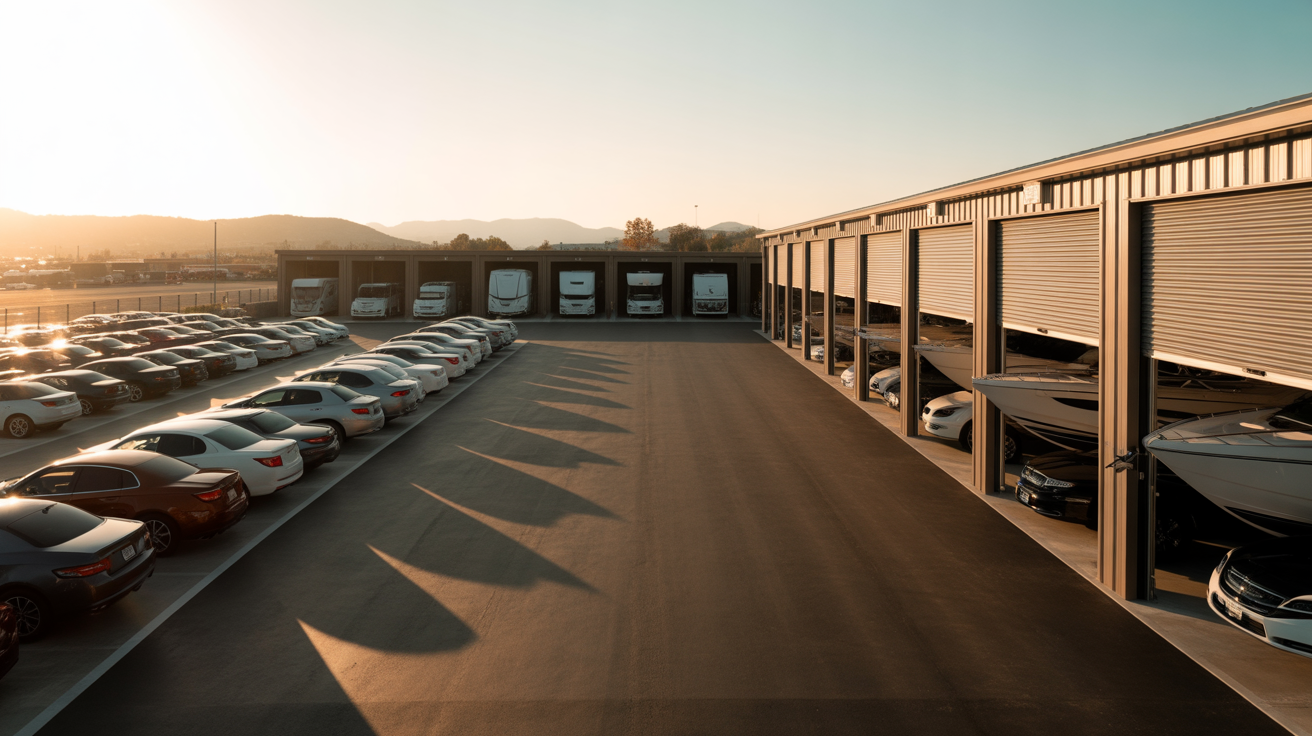
Standard vehicles require a 10x20 enclosed unit or dedicated parking space. At Estes Park Storage, our outdoor parking options provide secure storage for cars, trucks, boats, motorcycles, and trailers. This option suits your needs if you only need vehicle storage without enclosed protection. Check the live rental page for current availability and pricing.
[FOOTER_IMAGE]Frequently Asked Questions About Storage Unit Sizes
What size storage unit do I need for a one-bedroom apartment?
A 5x10 unit (50 square feet) fits the contents of most one-bedroom apartments. This includes a queen mattress, a sofa, a dresser, a small table, and 20 to 30 boxes. If you have minimal furniture or are storing only partial contents, a 5x5 unit may be sufficient.
How many boxes fit in a 10x10 storage unit?
A 10x10 unit holds 100 to 150 medium boxes when stacked floor to ceiling with no furniture. With typical furniture included (bed, sofa, dresser), expect to fit 40 to 60 boxes. Stacking boxes three to four high maximizes the 8-foot ceiling height.
Can I store a car in a storage unit?
Yes, most standard vehicles fit in a 10x20 unit (200 square feet). Compact cars may fit in a 10x15. Measure your vehicle before renting: most sedans are 15 to 17 feet long and 6 to 6.5 feet wide. Add 2 feet on each side for door clearance when parking.
What is the cheapest way to estimate storage needs without a calculator?
Use the moving truck method: estimate what size truck you would need to move your items, then match it to a unit size. A 10-foot truck equals a 5x10 unit; a 16-foot truck equals a 10x10; a 20-foot truck equals a 10x15. This provides a reliable estimate within one size category.
How much does storage unit size affect monthly cost?
Costs increase roughly proportionally with size. A 5x5 unit typically costs $45 to $75 per month. A 5x10 runs $75 to $150. A 10x10 costs $100 to $300. A 10x20 ranges from $150 to $400. Location, climate control, and facility amenities also affect pricing. Right-sizing saves 20 to 40 percent compared to renting the largest available unit.
Should I size up or down if I am between two unit sizes?
Size up. The cost difference between adjacent sizes is typically $30 to $180 per month, while the inconvenience of an overstuffed unit, potential damage to items, and possible mid-lease upgrades cost more in time and money. The extra space also allows for better organization and easier access.
Making Your Final Decision
After completing your inventory and calculations, visit the facility to see unit sizes in person. Many people find that seeing a 10x10 space helps them visualize how their belongings will fit. At Estes Park Storage, our team can walk you through available units and help you determine which size to suit your needs.
Our facility features 24/7 access, gated entry, LED lighting, and surveillance cameras to protect your belongings. Learn more about our security features and facility amenities to understand how we cater to your storage needs.
Month-to-month rentals provide flexibility if your needs change. Start with your calculated size, and adjust after the first month if necessary. Most customers find their initial calculation accurate within one size category when following the steps outlined above.
|